Lightwheel Introduces EgoSuite
A High-Quality, Multi-Modality, Globally Scalable Egocentric Human Data Solution
Lightwheel Team
Dec 4, 2025

Showcase of world-scale egocentric human data collected by Lightwheel EgoSuite across diverse regions, environments, and task types for training Embodied AI.
Robotics foundation models and world models are advancing at unprecedented speed, yet they all face the same fundamental constraint: the field lacks sufficient, diverse, and high-quality robot-usable data. High-quality data, such as simulation-ready (SimReady) and physically accurate assets, is critical to close the sim-to-real gap and support real-world performance in robots. Lightwheel approaches this challenge through the lens of the Embodied AI "data pyramid", a structure that summarizes the industry’s main data sources and their inherent tradeoffs.
Figure 1. A visual “data pyramid” illustrating the landscape of robot-training data sources, from abundant web and human videos at the base, to synthetic simulation data in the middle, and scarce high-value real-world robot data at the top. This conceptual framework was originally proposed by Yuke Zhu.
At the bottom of this pyramid lies web data and human videos, massive in scale and diversity, but fundamentally missing the first-person, contact-rich interaction signals required for manipulation and physical reasoning. At the very top sits real-world data (real-robot teleoperation data), which provides exactly those high-value action trajectories, but cannot scale: teleoperation data requires physical robot hardware, controlled lab environments, slow operator workflows, and cannot be deployed across the messy, varied real-world environments where robots must eventually operate.
This gap between “diverse-but-shallow” web data and “valuable-but-unscalable” teleoperation data has pushed the field toward a clear consensus: Embodied AI needs robot-agnostic data source, the sources that capture diverse action at scale without requiring a physical robot in the loop. Within this space, two categories have become especially important.
Synthetic data provides controllable environments, consistent annotation, and the ability to generate large volumes of structured demonstrations independent of hardware constraints.
Egocentric human data, meanwhile, sits within the broader web data & human videos layer of the data pyramid, but stands apart in one crucial way: it directly captures real human interaction from a first-person perspective. This makes it far more aligned with the manipulation, contact, and tool-use behaviors that robots must ultimately learn, while retaining the scalability benefits of being independent from physical robot platforms.
Across industry and research, egocentric human data is emerging as a foundational requirement for Embodied AI and world-model training. It represents the key data layer the field is converging toward as models grow and traditional data sources fall short.
The Lightwheel EgoSuite
To address this industry-wide data shortage, Lightwheel is introducing a major addition to its data ecosystem: a full-stack egocentric human data solution – the Lightwheel EgoSuite, built specifically for Embodied AI and world-model development. The solution combines multiple capture devices, large-scale global field operations, and a unified data-management and post-processing platform, enabling industrial-scale egocentric data collection and structuring. By producing action-centric, contact-rich, multimodal recordings across diverse real environments, the Lightwheel solution delivers the scalable, robot-agnostic dataset that modern robotics models urgently require.
Lightwheel EgoSuite promotional video, showcasing how our worldwide operations generate diverse, large-scale egocentric human data for training Embodied AI and world model
High-Quality Annotation
Our post-processing stack converts raw egocentric human videos into structured, learning-ready annotations for robot training.
We provide three types of annotations at production scale: 3D hand pose, 3D full-body pose, and frame-accurate semantic labels.
Both hand pose and full-body pose are tracked in 3D with millimeter-level accuracy and remain stable under self-occlusion and close-range object interaction.
Semantic annotations are generated with frame-accurate action segmentation and explicit language descriptions. Each demonstration is labeled with scene context, action segments, and manipulated objects, enabling precise alignment between visual observation, physical motion, and task semantics.
High-quality 3D hand pose reconstruction with stable tracking under object interaction and self-occlusion.
Global Operations across Real Environments
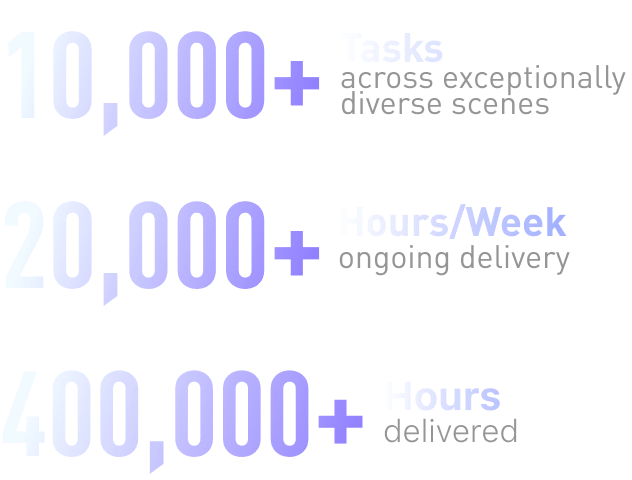
Underpinning the hardware is Lightwheel’s global field-operations network, built specifically for egocentric human data at industrial scale. 10,000+ diverse tasks across 500+ environments run in parallel across 7 countries, producing more than 20,000+ hours of demonstrations every week. These sessions span a wide range of real-world settings—homes and daily living spaces, commercial and service environments, manufacturing floors, logistics and warehousing sites, outdoor and field tasks, and public infrastructure. This operational footprint ensures the geographic, cultural, and task diversity required for training generalist robots and world models that must function reliably across varied, unstructured human environments.
Multi-Modality Capture Devices for Scalable Human Demonstrations
To support diverse robotic learning requirements, we operate multiple classes of robot-native capture devices: an integrated VR-based capture unit equipped with a broad suite of head-mounted multimodal-sensors; a custom exoskeleton-based capture system that provides high-precision, high-quality recording of dexterous human manipulation; and a UMI-aligned gripper interface that mirrors robot end-effector kinematics for direct trajectory supervision. Across these devices, we record rich multimodal signals: RGB-D, upper-body and hand pose, tactile sensor data. The combined stack allows us to capture the full spectrum of human interaction patterns that robots must ultimately learn. These capture devices are further supported by NVIDIA’s AR/VR stack for real-time human pose and hand tracking, and NVIDIA Jetson Orin NX for efficient on-device inference within our capture workflow, ensuring low-latency, high-stability data capture at scale.
Multi-Hardware
Multi-Modality
Figure 2. Modality capture devices combining VR units, exoskeleton interfaces, and UMI-aligned grippers to record RGB-D, pose, tactile, and other interaction signals.
Work with Lightwheel
As scaling laws continue to hold for Embodied AI and world models, the limiting factor is no longer model capacity, it’s the availability of dense, diverse, robot-usable data. Egocentric human data offers the most scalable path toward bridging this gap, and Lightwheel has already delivered over 300,000 hours of high-quality egocentric data across real homes, factories, warehouses, and public environments worldwide.
With the Lightwheel EgoSuite, robotics teams can access the diverse, high-quality, and large-scale dataset required to train next-generation generalist robots and world models.
Lightwheel is now partnering with leading teams in Embodied AI, world-model development, and frontier robotics research.
To explore datasets, request a demo, or discuss custom scenarios, contact Lightwheel for early access.