SimReady: The Physics Data Infrastructure
for Physical AI
Introducing the Lightwheel SimReady System and our collaboration with
Newton Physics Engine to bridge the sim-to-real gap.
Simulation Needs a Physics
Infrastructure Layer
Infrastructure Layer
Physical AI is entering an era of foundation-scale models, where robots learn from massive datasets and are trained across millions of simulated interactions. In this paradigm, simulation is no longer just a development tool. It is becoming the data infrastructure that powers robot learning.
However, today’s simulation environments remain weakly connected to real-world physics. Physical parameters such as friction, deformation, and contact dynamics are often
approximated rather than measured, causing policies trained in simulation to fail when deployed on real robots.
Benchmarks frequently measure the behavior of the simulator rather than the behavior of the physical world. As a result, progress in simulation does not always translate into progress in real-world robotics.
At Lightwheel, we believe the missing layer is physics data infrastructure: a systematic way to measure real-world physical behavior, translate it into accurate simulation physics, and generate simulation assets at scale.
To address this challenge, we introduce the Lightwheel SimReady System, a unified architecture that grounds simulation in real-world physics while scaling asset generation for modern Physical AI workloads. Complying with OpenUSD-based content specifications, SimReady assets are structured, machine-readable descriptions of geometry, physics, and semantics, so the same asset can be trusted across measurement, simulation, and real-world deployment.
The Core Challenge: Physically Accurate
Simulation Assets at Scale
Can we produce physically accurate simulation assets at scale?
Many simulation assets today focus primarily on visual realism. While geometry may appear accurate, the physical behavior of objects, how they move, deform, and interact, often remains simplified.
Without systematic grounding in real-world physics:
- policies trained in simulation fail during real-world deployment
- sim-to-real transfer remains inconsistent
- simulation benchmarks become difficult to interpret
Closing this gap requires a pipeline that connects real-world measurement, physics solving, and scalable asset generation.
The SimReady Architecture:
Measure → Solve → Generate
Together, these capabilities form a closed-loop system that links the physical world with scalable simulation infrastructure.
Measure: Grounding Simulation in
Real-World Physics
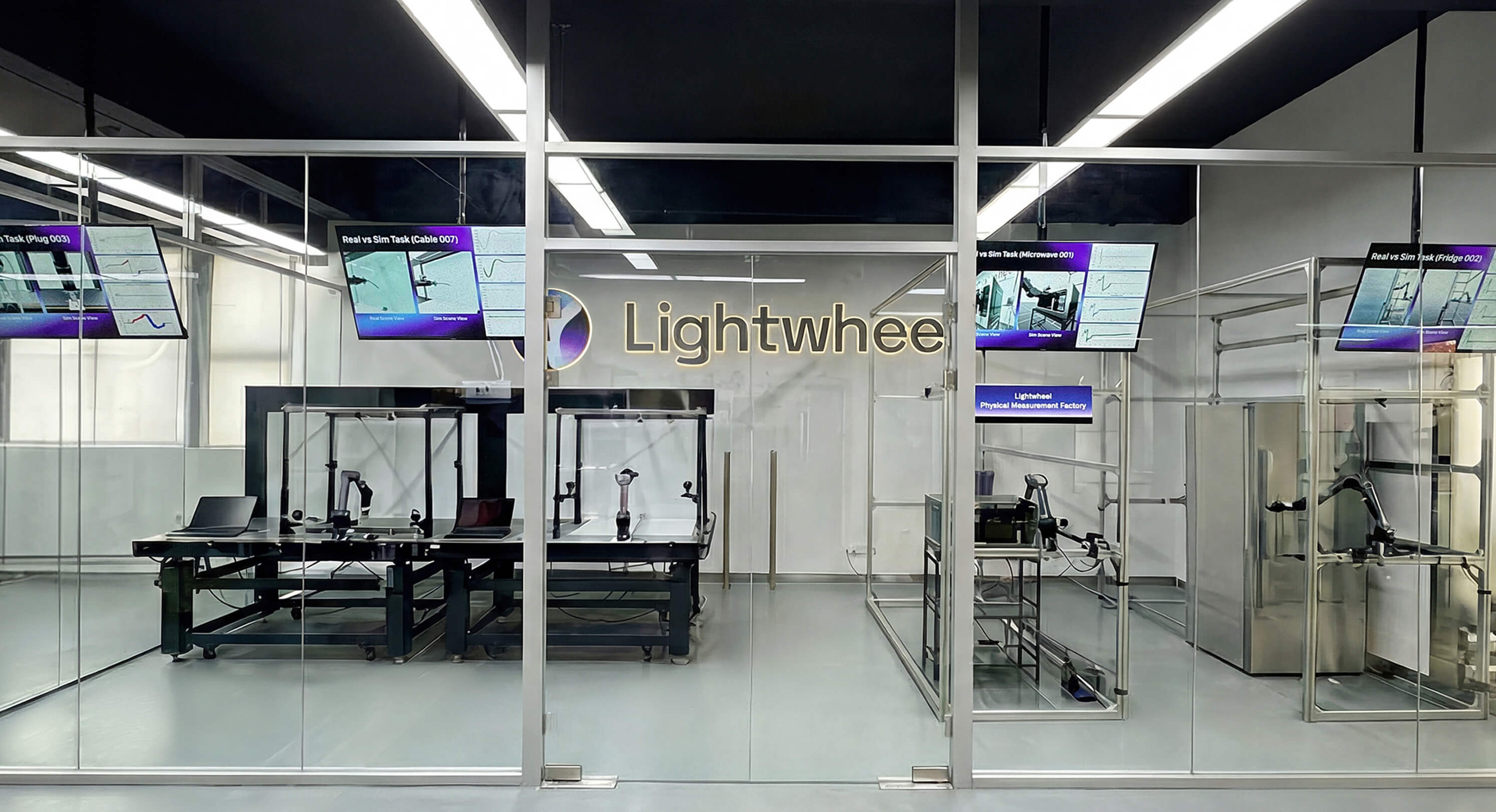
Lightwheel has built a Physical Measurement Factory designed to systematically measure how real objects behave. Using precision instruments and repeatable experimental setups, we capture key physical properties such as:
- friction coefficients
- stiffness and deformation behavior
- contact dynamics
- joint constraints and motion limits
These measurements are translated into the physical parameters that define how assets behave inside simulation environments.
Rather than manually estimating physics values, SimReady assets are grounded in measured physical data. Real-to-sim validation tests compare robot interactions in simulation with controlled experiments in the physical world, allowing simulation environments to be continuously calibrated to reality.
Solve: Translating Measured Physics
into Simulation Behavior
Robotic environments increasingly involve complex physical interactions, including:
- rigid bodies and articulated mechanisms
- deformable materials such as cloth and cables
- particle systems and fluids
- multi-contact manipulation scenarios
Traditional rigid-body simulators struggle to capture many of these interactions accurately.
A robust physics solving layer is therefore essential to translating measured physical properties into reliable simulation behavior.
Generate: Scaling SimReady
Assets and Environments
Powered by OpenUSD, Lightwheel has developed standardized pipelines to produce large volumes of physics-consistent simulation assets and environments while preserving alignment with real-world physics. In practice, this means SimReady assets are authored conforming to content profiles that can be reused across multiple engines as neutral inputs.
These pipelines enable:
- large-scale teleoperation data collection
- reinforcement learning across thousands of environments
- reproducible benchmark evaluation
- systematic scenario generation
The result is a scalable asset production system where physical realism and simulation scale grow together.
Collaboration with NVIDIA: Advancing
Simulation Physics with Newton
Newton provides a unified simulation framework where:
- rigid bodies
- articulated systems
- deformable materials
- particles and fluids
can interact within a consistent physical representation.
OpenUSD provides the shared scene and data model that connects SimReady assets to the Newton Physics Engine, so measured physical properties flow cleanly from SimReady content into Newton’s multi-physics solvers. By standardizing on OpenUSD, Lightwheel can produce neutral assets that feed Newton, Isaac Sim, and other OpenUSD-based robotics workflows.
Built for GPU execution, Newton enables thousands of interactions to be simulated in parallel, supporting the scale required for modern robotics training and large-scale benchmark evaluations.
Together with NVIDIA, Lightwheel is contributing to the Newton ecosystem by:
- co-defining SimReady asset standards that ensure physical accuracy and solver efficiency
- implementing USD-based parsing for deformable assets within Newton’s simulation pipeline
- collaborating on extending solver capabilities for complex manipulation scenarios
These efforts help ensure that SimReady assets remain physically consistent across training, evaluation, and real-world deployment.
In parallel, Lightwheel is working with industrial partners including Samsung and Analog Devices to validate simulation in real-world robotics scenarios.
- With Samsung, Lightwheel is co-developing and calibrating the Newton physics engine to enable Samsung’s assembly robots to master complex cable-handling tasks in simulation, improving precision and accelerating assembly workflows.
- With Analog Devices, Lightwheel integrates its physics measurement and simulation infrastructure with ADI’s sensing technologies to build sensor-aware simulation that aligns simulated force, torque, and contact signals with real industrial sensor measurements for high-precision manipulation and insertion tasks.
Lightwheel Joins the Newton Technical
Steering Committee
Within the Newton project, Lightwheel will focus on advancing the SimReady asset ecosystem, including:
- SimReady standards and schema development for more complex physical assets
- Solver advancement and real-world calibration for more physically grounded simulation
- Real-to-sim asset tuning and tooling for more reliable simulation workflows
- Reference assets, scenes, and technical feedback for the Newton ecosystem
We believe that high-quality, physically validated assets are foundational to the long-term success of robot learning platforms, and we are excited to help establish strong standards for asset quality, reproducibility, and ecosystem interoperability.
Toward Closed-Loop Simulation
Infrastructure for Physical AI
The SimReady System transforms simulation into a closed-loop pipeline grounded in real-world physics.
By linking measurement, physics solving, and scalable asset generation, SimReady enables robotics teams to train, evaluate, and iterate at foundation-model scale while maintaining physical fidelity.
Combined with the Newton Physics Engine, this approach helps ensure that progress in simulation more reliably translates to progress in the real world.
Our goal is to make simulation a dependable infrastructure layer for Physical AI, one where digital experimentation and real-world robotics remain tightly aligned.
As the SimReady specifications continue to mature, developers will be able to treat OpenUSD-based SimReady assets as a shared, physics-grounded foundation for their Physical AI applications.